The insult was meant to cut, a public dismissal in front of the new recruits. “You don’t belong here, sweetheart,” Master Chief Damian Kovac barked, his voice echoing in the training bay. I kept working, my hands moving through the familiar ritual of clearing a jammed rifle. The words were just noise. At twenty-seven, with two combat deployments behind me, verbal barbs from a man who’d spent his career in safe training commands couldn’t sting. But Kovac wasn’t after a reaction; he was after a demonstration. He ordered me onto the mat for a chokehold drill, a thinly veiled excuse to use his hundred-pound advantage to humiliate me. He cinched the hold with vicious intent, not to teach, but to break. As the air left my lungs, the panic tried to rise. Then, a memory surfaced—a frozen ridge line in Afghanistan, my team leader’s last order in my ear: “Stay technical.” The fear dissolved into cold geometry. I used his own weight against him, broke the hold, and left him gasping. The victory was silent but total. In that moment, he had no idea he’d just stopped poking a soldier and started provoking a monster with a classified history.
The public humiliation sealed my fate as his target. For the next three weeks, my life became a gauntlet of punitive duties, lost paperwork, and poisonous rumors meant to isolate me. I trained alone, ran the beaches at night, and clung to the memory of the men I’d served with, the ones who understood the real cost of war. Kovac mistook my silence for weakness. He finally unveiled his master stroke: a brutally rigorous, eighteen-hour Instructor Readiness Evaluation, a legal framework designed to break me physically and end my career. When he announced it, a challenge glinting in his eyes, I asked for a single clarification about the final combatives round. My calm question unnerved him. He didn’t understand that the exhausted woman standing before him was already calculating windage and elevation, just like on a long-range shot. The ghost of my combat past was stirring, and Kovac had just painted a target on himself.
The evaluation was a symphony of exhaustion. We rucked miles under a punishing sun, our bodies weighed down by sixty pounds of gear. I watched younger, prouder men burn out early, while I conserved energy, moving with the steady trot of a wolf, not the frantic sprint of a rabbit. On the range, fatigue made hands shake and eyes blur. Kovac shot aggressively, scoring respectably. When it was my turn, the smell of cordite was a homecoming. I wasn’t on a California range; I was back in Sangin, covering my team’s retreat. Each shot was a promise kept. I posted a near-perfect score, a silent rebuttal written in bullet holes. The tactical planning test was meant to be my downfall, but they assumed a shooter couldn’t think. They didn’t know I’d helped plan real raids. My solution was not from a textbook; it was from experience, leaving Kovac with no flaw to critique.
Everything culminated in the gym, under stark lights on blue mats. My body was a collection of aches, running on fumes and sheer will. Kovac, though tired, still wielded his size like a club. The first round was a storm of heavy blows I absorbed, biding my time. He was frustrated, clumsy. In the second round, he took me down, his weight crushing, his hands searching for a fight-ending choke. He made the critical mistake, overcommitting his balance. I didn’t fight his force; I redirected it. In a blur of motion, I reversed our positions and locked in a choke of my own. He fought it, his pride warring with the creeping darkness, until survival instinct won. His hand tapped the mat. The silence that followed was louder than any cheer. He had thrown everything at me, rigged the entire game, and still lost. The fear in his eyes as he gasped on the mat was the first true thing I’d seen from him.
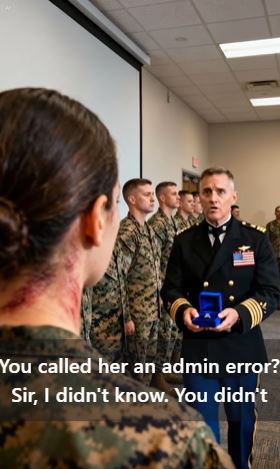
Justice arrived not from my hands, but from a Marine Colonel in full dress blues the next morning. He came to correct the “clerical error” of Kovac’s disrespect. Before the entire command, he read my classified citation—the ten confirmed kills on a ridge line, the coordinated rescue under fire, the refusal to leave anyone behind. He pinned the Navy Cross to my chest, a medal I’d never worn because it felt like a trade for a life. Kovac was relieved of duty, his career ended, sentenced to the very admin desk he’d mocked. As I stood on the beach that evening, the medal back in its box, I felt no triumph, only a weary closure. The silent ghost was back in the machine, not for vengeance, but to ensure the next generation of warriors understood the difference between a fight and a flex, and that true strength is earned in silence, not shouted in a gym.