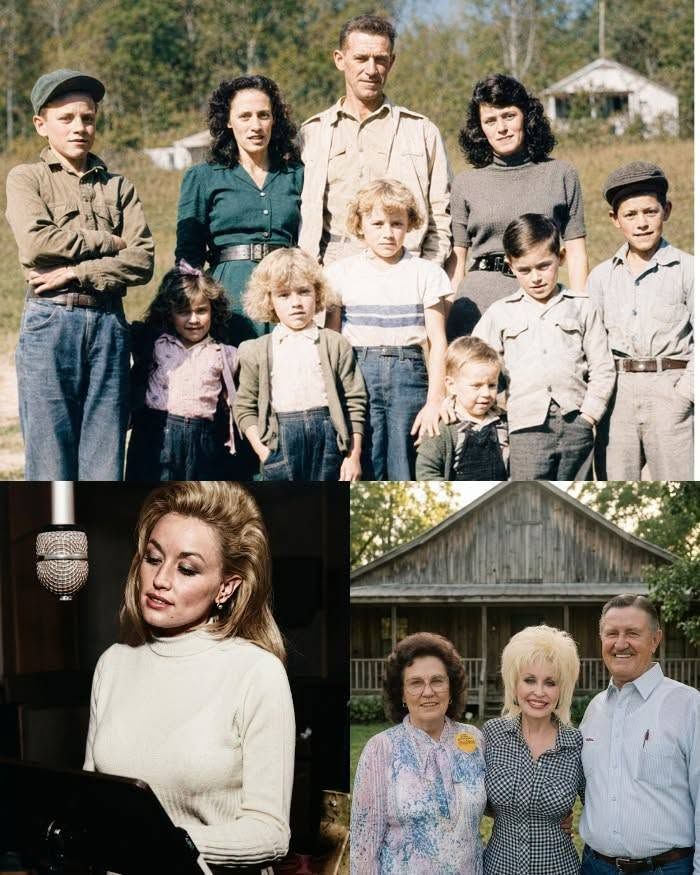
Before Dolly Parton spent money on rhinestones, business ventures or the trappings of celebrity, she wanted to change the daily lives of the two people who had sacrificed everything to raise twelve children. The house she helped provide—and the blue truck she bought for her father—represented more than financial success. They were a daughter’s answer to years of cold mornings, unpaid bills and love expressed through exhausting labor.
Before the money came, there was a cabin full of children
Long before Dolly Parton understood publishing royalties, television contracts or record sales, she understood the sound of hardship.
It was the wind slipping through the gaps of a small mountain cabin. It was rain striking a roof that offered only limited protection. It was the movement of fourteen people—twelve children and their parents—trying to build a life inside a home with no electricity or indoor plumbing.
Dolly was born on January 19, 1946, in rural Sevier County, Tennessee. She was the fourth child of Robert Lee Parton Sr. and Avie Lee Owens Parton, who eventually raised six daughters and six sons in the foothills of the Great Smoky Mountains.
The Partons’ home is often described as either a one-room or two-room cabin, depending on whether the small kitchen and sleeping area are counted separately. Whatever terminology is used, the reality remains the same: it was far too small for such a large family.
The walls were reportedly lined with newspaper to provide additional insulation. Water had to be carried rather than summoned from a faucet. Clothes were washed by hand. Meals were prepared with basic equipment, often from food the family grew, gathered or managed to obtain through Lee Parton’s relentless labor.
There was little privacy and almost no unused space. Children slept together, shared clothing and learned early that survival depended on cooperation. What one person possessed often belonged, in practice, to everyone.
Yet Dolly would resist portraying her childhood as nothing but misery. She remembered music, storytelling, faith and the fierce protection of her family alongside the material deprivation. Her mother filled the cabin with old ballads and imaginative stories. Her father worked the land and accepted construction jobs to keep food on the table.
They were poor, but the children were not unloved.
That distinction would shape the way Dolly later used money. She did not regard wealth only as a means of acquiring beautiful things. She understood it first as relief—the power to make sure the people she loved no longer had to face every difficulty alone.
The father whose work became Dolly’s first business education
Robert Lee Parton could not read or write, a fact that caused him embarrassment in a world where formal education often determined how seriously a person was treated. Dolly, however, repeatedly described him as one of the smartest men she had ever known.
His intelligence was practical.
He understood livestock, crops, weather, bargaining and the value of a dollar. He worked as a sharecropper, tended tobacco and accepted construction jobs when farming did not provide enough money. Supporting a household of fourteen required constant calculation. Every small resource had to be stretched, repaired or repurposed.
Dolly watched him leave for physically demanding work and return home carrying the weight of responsibilities he could never set aside. His hands and back absorbed the price of keeping the family alive.
Her ambition was partly born from that witness.
She wanted to sing because music was already inside her, but success also represented the possibility of altering her parents’ lives. Nashville was not merely a place where she hoped to become famous. It was where she might earn enough money to loosen poverty’s grip on the people who had raised her.
This makes the popular story about her “first major royalty checks” emotionally believable, but it requires careful phrasing. Reliable accounts confirm that Dolly used her early success to help her family, purchased property and later bought her father a large blue truck. However, available primary reporting does not establish one specific royalty check that simultaneously funded a brick house, indoor plumbing and the truck.
The story appears to compress a series of gifts and improvements into one symbolic moment.
That does not make the underlying devotion false. It simply means memory has been shaped into a cleaner narrative than life usually provides.
Dolly’s support grew as her income grew. Early songwriting success, recordings and her regular role on The Porter Wagoner Show gave her financial stability she had never known. For the first time, she could do more than promise her parents a better life.
She could begin building one.
Nashville finally gave her the power to send something home
Dolly moved to Nashville in 1964, immediately after graduating from high school. She arrived with songs, determination and little protection against failure.
The city did not instantly reward her.
She recorded early material and worked to establish herself as a songwriter, finding greater initial success through compositions recorded by other performers. Her breakthrough accelerated after she joined Porter Wagoner’s nationally syndicated television show in 1967.
The partnership introduced Dolly to a large country audience. Her distinctive voice, appearance and personality made her difficult to ignore. Duets with Wagoner became popular, while her solo recordings gradually established her as an artist capable of standing independently.
Money began arriving, though not all at once and not without industry complications. A singer’s apparent success did not automatically equal wealth. Managers, publishers, record labels, production expenses and touring costs all claimed portions of the income.
Dolly nevertheless understood something crucial: ownership mattered.
She protected her songwriting catalog and treated publishing rights as the foundation of long-term independence. The decision would eventually make her one of the most financially successful songwriters in music history.
But before the empire, there was family.
The young woman who had grown up carrying water could now help create a home where her parents would no longer depend on the same exhausting routines. The daughter who had watched her father struggle to secure transportation could place a truck key in his hand.
These purchases were not extravagant by celebrity standards. There was no mansion overlooking Los Angeles, no fleet of imported automobiles and no public ceremony arranged for cameras.
The house and truck represented practical luxury: stability, warmth, mobility and dignity.
They were exactly the kinds of things Lee and Avie Lee had spent years trying to provide for their children but could rarely afford for themselves.
A brick house, running water and a story that grew with time
The most widely shared version of the story describes Dolly buying her parents a spacious brick house on flat Tennessee ground. Inside were heating, indoor plumbing and a kitchen faucet capable of producing hot water.
According to the viral telling, Avie Lee turned the faucet, watched the warm water enter the sink and cried.
It is a beautiful image, but it should not be presented as a documented eyewitness scene without a reliable first-person source. Publicly available accounts establish the family’s lack of running water during Dolly’s childhood and confirm that Dolly later helped her parents improve their circumstances. The precise kitchen moment, however, is not firmly documented in the same way as Dolly’s statements about the blue truck.
The emotional truth behind the image is nevertheless easy to understand.
For someone who has always had indoor plumbing, hot water can seem too ordinary to symbolize success. But to a woman who washed clothing for a family of fourteen without modern equipment, turning a knob and receiving heated water would have represented a profound change in physical labor.
A faucet could return hours to a day.
A washing machine could spare aching hands.
Reliable indoor heat could transform winter from a constant domestic battle into a season a family could endure with less fear.
A bathroom inside the house could provide privacy that had been unimaginable in a cabin crowded with children.
The importance of the new home was not architectural. It was bodily. It reduced the weight carried by the people living inside it.
That is what money meant to Dolly before it became the capital behind theme parks, production companies and worldwide philanthropy. It meant that her mother could perform fewer exhausting tasks and that her father could look upon something permanent as the result of his daughter’s success.
Dolly could not give her parents back the years poverty had taken from them.
She could make the years ahead gentler.
The blue truck her father refused to surrender
Among the most firmly sourced parts of this family story is the gift Dolly bought for her father.
“My daddy always drove a truck,” she recalled. “I bought my daddy a big blue truck, and he was always so proud of that.”
Lee Parton valued the vehicle so deeply that he would not trade it for another one. Dolly later said the truck remained in the family even after his death, preserved on property connected to him.
The gift was practical, but its meaning extended far beyond transportation.
Lee had spent his life measuring purchases against the immediate needs of twelve children. A reliable vehicle could easily be postponed when food, clothing and shelter required every available dollar. Fathers in such circumstances often learn to treat personal comfort as an unnecessary expense.
Dolly’s gift reversed that pattern.
For once, Lee did not have to calculate whether the family could afford something he needed. He did not have to borrow, repair an aging vehicle or continue making do. His daughter had bought him a new truck because she remembered what his labor had cost.
The color also remained vivid in Dolly’s memory: blue.
That detail makes the story feel intimate. She did not speak only of “a vehicle” or “financial help.” She remembered the object exactly as her father saw it—the big blue truck that told him his daughter had noticed every difficult mile.
Dolly discussed the gift while recalling what she first wanted to do for her parents after finding success. Billboard
Lee’s pride in the truck would have been complicated. It was a sign that his daughter had escaped the economic boundaries that governed his life. It was also evidence that the child he had struggled to provide for had become capable of providing for him.
For a fiercely independent working man, accepting such help may not have been emotionally simple.
Dolly understood how to preserve his dignity.
She did not present the truck as charity.
It was a daughter’s gift to her daddy.
Success could ease poverty, but it could not erase its memory
It is tempting to describe the house as the purchase that erased Lee Parton’s guilt over his family’s poverty. That conclusion, however, goes beyond what any outsider can know.
Parents who struggle financially often carry complicated feelings that cannot be removed by a deed, a vehicle or a bank balance. Lee may have regretted what he could not provide, but Dolly never defined him by those limitations.
She credited him with giving her discipline, judgment and an instinctive understanding of value. Though he lacked formal literacy, she trusted his practical intelligence. The man who could not read a contract had taught her how to recognize the worth of work.
Her later philanthropy shows how deeply his experience remained with her.
In 1995, Dolly founded the Imagination Library in Sevier County to send free books to young children. She created the program partly in honor of her father, whose inability to read had limited him despite his intelligence.
Lee took enormous pride in the project and helped promote it locally. Dolly later referred to him as one of the smartest people she knew, separating his lack of schooling from any lack of ability.
The program eventually expanded far beyond Tennessee, placing hundreds of millions of books into children’s homes. What began as a daughter’s response to her father’s educational disadvantage became an international literacy movement.
This was the larger pattern of Dolly’s life.
She did not merely escape the conditions of her childhood. She converted them into instructions.
Remember the cold house, then help a family recover after a disaster.
Remember the father who could not read, then send books to children.
Remember a region with few opportunities, then build businesses that employ local people.
Remember how it felt to possess little, then treat wealth as something that should circulate toward need.
The house she helped provide for her parents was not an isolated act. It was an early expression of the philosophy that would define her legacy.
What the hot-water story really asks us to remember
Whether Avie Lee literally cried at a hot-water faucet exactly as the viral account describes is less important than telling the broader history honestly.
Dolly Parton was raised in a small Tennessee cabin without electricity or running water. Her parents raised twelve children through relentless work, ingenuity and sacrifice. When their daughter began earning money, she used part of it to improve their lives. She bought her father a blue truck he treasured and helped secure greater stability for the family.
Those verified facts require no exaggeration.
The temptation to invent or embellish a perfect scene usually comes from a reasonable emotional need. We want one image capable of containing an entire transformation. A mother turning a faucet and crying gives poverty, success and gratitude a single visible form.
But real lives rarely change in one cinematic instant.
The Parton family’s movement out of hardship occurred through accumulating steps: one song placed with another singer, one television appearance, one royalty payment, one repaired home, one piece of property and one gift carried back from Nashville.
The transformation was gradual, just as the sacrifice had been gradual.
Lee and Avie Lee had provided for their children one meal, one garment and one difficult day at a time. Dolly returned that devotion in the same way—through decisions repeated across decades.
The deepest meaning of the story is therefore not that wealth allowed Dolly to rescue her parents. Such language would wrongly portray them as helpless and erase the labor that made her survival possible.
They had already rescued one another many times.
Lee rescued the family through work.
Avie Lee rescued it through caregiving, music and imagination.
The older children helped raise the younger ones.
Relatives encouraged Dolly’s talent and helped her reach opportunities beyond the mountains.
When Dolly earned enough to buy comfort, she was not becoming the family’s first giver. She was joining a long tradition of giving with the new resources available to her.
That is why the blue truck mattered.
That is why the better house mattered.
And that is why the image of warm water continues to move people even when its most dramatic details cannot be independently verified.
The story asks us to reconsider what prosperity is for.
Dolly could have used her first meaningful earnings to announce that she had become different from the people of Locust Ridge. Instead, she used money to reduce the burdens those people had carried.
Years later, her name would appear on a theme park, foundations, books, films and businesses. Yet one of the clearest measures of her success remained profoundly ordinary: her father had a dependable truck, and her mother lived in a home where water no longer had to be carried inside by hand.
To most of the world, Dolly Parton had arrived when audiences learned her name.
To Dolly, perhaps she had truly arrived when success finally reached her parents’ front door.