Chapter 1: The Shadows in the Driveway
My son stood in the center of the kitchen, gripping a half-empty glass of pulp-free orange juice, asking a question I did not know how to answer. In the next sixty seconds, his casual, innocent observation was going to either violently detonate my eleven-year marriage or miraculously salvage it. The terrifying reality was, I had absolutely no idea which outcome was approaching.
“Dad,” Woody began, his voice perfectly level, “why does Mom change her shirt in the driveway every single day?”
I stared at him. He was nine years old, clad in a faded graphic tee, looking up at me as if this were an entirely routine inquiry—as mundane as asking for help with a math fraction.
A cold dread coiled in my gut. I forced my expression to remain neutral. “What do you mean, buddy? Mom?”
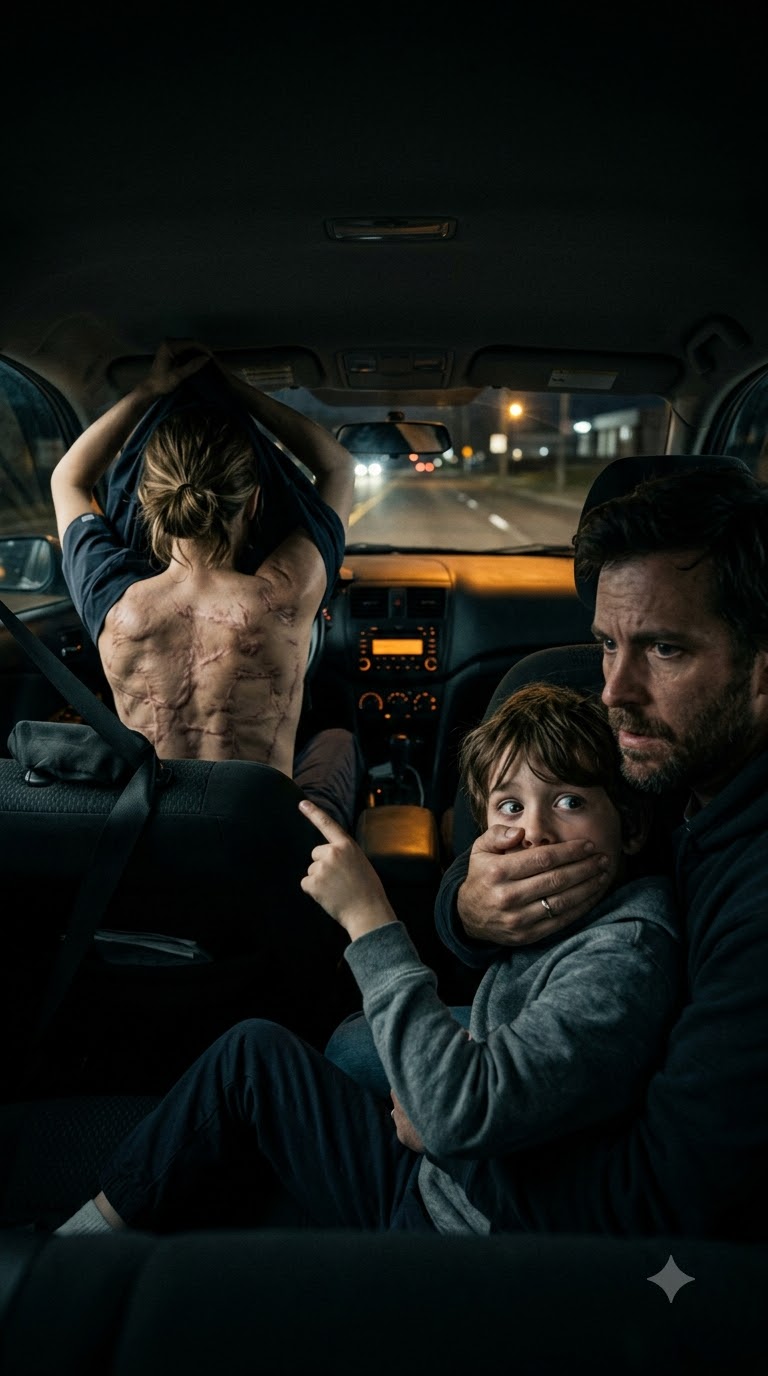
“Yeah. When she comes home from work, she sits in the car for a really long time. Then she changes her shirt. I watch from my window.” Woody paused, taking a slow sip of his juice, oblivious to the fact that he was dismantling the foundation of my reality. “Sometimes she takes off her shirt and puts on a totally different one from a plastic bag. Then she comes inside.”
My hands turned to ice, freezing around the ceramic coffee mug I was holding. “How often does this happen, Woody?”
“Every day for like… months, maybe.” He paused, his brow furrowing slightly. “Sometimes she cries first, Dad. She sits there and cries, and then she wipes her face, changes her shirt, and comes inside smiling.”
The mug slipped from my paralyzed fingers. It hit the granite counter with a sharp, heavy thwack. Hot, dark coffee spilled everywhere. My brain, hardwired for logical deduction as a software engineer, bypassed all rational alternatives and sprinted directly toward the most devastating conclusion: My wife was having an affair.
Jen is an ICU nurse at Mercy General Hospital. She grinds out twelve-hour shifts, grueling, visceral work. We had been married for eleven years. I sincerely believed we were happy. But now, my nine-year-old was exposing a clandestine ritual happening every single day.
“Thanks for telling me, Woody,” I managed to say, grabbing paper towels. “I’ll… check on it.”
That night, my paranoia took root. I watched from the window as Jen parked her car at 7:25 p.m. She didn’t come inside until 7:40 p.m. When she finally walked through the door, she kissed my cheek and asked about my day, her smile flawless.
But it wasn’t just the driveway. Later that night, the true horror began.
At 2:00 a.m., I woke up to an empty bed. The house was dead silent, save for the faint sound of running water coming from the master bathroom. I swung my legs out of bed and crept down the hallway. The bathroom door was ajar, spilling a slice of pale yellow light onto the hardwood floor.
I peeked inside and my breath hitched.
Jen was standing at the sink. She was fast asleep—her eyes were open, but they were entirely vacant, glassed over with a terrifying emptiness. The water was running scalding hot, steam billowing around the mirror. She was aggressively scrubbing her hands with a stiff-bristled nail brush, her skin rubbed completely raw, angry and red.
“Jen?” I whispered.
She didn’t hear me. Her lips were moving rapidly, muttering a frantic, nonsensical litany. I leaned in closer, my heart hammering against my ribs.
“Eighty over forty… push the epi… where is the pulse… I can’t find the pulse… God, there’s so much… push the epi…“
I reached out and touched her shoulder. She flinched so violently she knocked a glass tumbler off the counter. It shattered into a hundred pieces. She blinked, pulling herself out of whatever nightmare she was trapped in, looking at her bleeding hands and the broken glass in absolute terror.
“Jason? What… what am I doing?” she whimpered.
I held her as she cried, but my mind was spinning out of control. Was she washing off the guilt? Was she having a nervous breakdown because of a double life? The secrets were multiplying, and I realized with sickening clarity that the woman sleeping next to me was a complete stranger.
Chapter 2: The Red Herring
The following day, when Jen was at the hospital and Woody was at school, I committed the ultimate breach of trust. I walked into the garage and meticulously searched her sedan.
I checked the glove compartment. Normalcy. Then, I reached beneath the passenger seat. My fingers brushed against crinkling plastic. I pulled out a crumpled, opaque shopping bag. My palms were slick with sweat as I opened it.
Inside was a light blue scrub top. But it wasn’t just stained with old, faded marks. Near the collar, there was a dark, unmistakable smear of fresh, rusted brown. Blood. And it wasn’t just a drop; it was a violent smear.
I dropped the bag onto the passenger seat, my stomach violently churning. I popped the center console. Buried beneath a pile of charging cables, I found a half-eaten parking receipt. The edges were gnawed on, as if someone had chewed it in a state of absolute, manic anxiety. The address on the stub was 447 Pine Street.
A luxury apartment complex downtown.
Why would my wife be paying for parking at an upscale apartment building multiple times a week? Why was there fresh blood on a hidden shirt? Was she involved in something illegal? Was her lover dangerous?
I retreated to the house, feeling like I was suffocating. When Jen came home that evening, she immediately jumped into the shower. She left her phone on the kitchen counter. I had never snooped on her phone in eleven years, but the blood on the shirt had pushed me past the point of morality.
I stared at the black screen. Suddenly, it lit up. A text message notification popped into the center of the glass.
N: You did well today. I know it hurts, but we have to go deeper tomorrow. Don’t hide this from Jason forever.
I stopped breathing.
N. A man. A lover. “Go deeper tomorrow.” The words were so ambiguous, so intimate, and so profoundly sickening. My wife was meeting a man named N at a luxury apartment, hiding blood-stained clothes, and lying to my face.
I heard the shower turn off upstairs. I backed away from the phone, my hands shaking uncontrollably. I didn’t know who N was, but I knew, with absolute certainty, that I was going to find out, and I was going to tear his life apart.
Chapter 3: The Suicide Note
Friday morning, the tension in the house was thick enough to choke on. Jen looked pale, her eyes rimmed with dark, bruised circles. Every time a car drove past our house, or my phone buzzed on the counter, she would flinch—a massive, full-body startle response, as if she were expecting someone to kick the door in.
After she left for work, I sat at my desk, trying to formulate a plan. I needed to confront her, but I needed all the pieces first.
At 3:30 p.m., Woody came home from school. He bounded up the stairs to his room, but ten minutes later, he walked into my office. His usual energetic bounce was gone. He looked small, holding a crumpled piece of lined notebook paper in his hand.
“Dad?” he asked, his voice trembling slightly. “I found this in the trash can in Mom’s bathroom. I was looking for a tissue.”
He handed me the paper. I smoothed it out on my desk. The handwriting was Jen’s, written in a frantic, heavy scrawl that had nearly torn through the paper.
I can’t take this anymore. My heart breaks every time I see them. I am living a lie in this house. The blood won’t wash off. I have to end this. Today.
The room spun. The floor completely dropped out from beneath me.
I have to end this. Today.
This wasn’t just an affair. She was either planning to leave us forever, or worse—much, much worse. The sleepwalking, the frantic hand-washing, the terror in her eyes, the blood. She was trapped in something horrifying, and she thought the only way out was to “end it.”
I looked at the clock. 4:00 p.m. She got off her shift at 3:30 p.m.
She wasn’t coming home. She was going to 447 Pine Street. She was going to N.
“Woody, go get your shoes,” I commanded, my voice entirely devoid of panic despite the hurricane in my chest. “I’m dropping you off at Grandma’s house. Right now.”
“Is Mom okay?” he asked, his eyes wide.
“Mom is going to be fine,” I lied. “I’m going to go get her.”
I drove like a madman. I dropped Woody off without an explanation, ignoring my mother’s frantic questions. I sped toward downtown Seattle, my heart beating a frantic, agonizing rhythm against my ribs. I had the address burned into my retinas. 447 Pine Street.
I pulled up to the luxury building at 4:45 p.m., abandoning my car in a loading zone. I sprinted into the lobby, bypassing the bewildered concierge, and jumped into the elevator.
The parking receipts I had found earlier in the week had a suite number scribbled on the back. 402.
The elevator doors opened on the fourth floor. The hallway was silent, lined with heavy oak doors. I marched down the carpeted corridor, every muscle in my body coiled tight, ready for violence. I was going to find N. I was going to save my wife, or I was going to watch my world burn down.
I stopped in front of door 402. I reached for the brass handle. It was unlocked.
I took a breath, stepped back, and shoved the door violently open.
Chapter 4: Room 402
The hallway of the fourth floor was suffocatingly quiet. It was the kind of heavy, insulated silence you only find in expensive, high-security buildings. The thick, plush carpet absorbed the frantic, heavy thud of my footsteps, rendering my approach entirely soundless.
My heart was hammering a violent, erratic rhythm against my ribs, the blood rushing in my ears so loudly it sounded like ocean static. My palms, slick with cold sweat, flexed and un-flexed at my sides. Every muscle in my body was coiled tight, humming with a toxic cocktail of adrenaline, absolute terror, and a primal, destructive rage.
I was walking toward Room 402.
In my mind, the narrative was completely cemented. I had found the bloody shirt. I had read the cryptic text message from “N” about “going deeper.” And, most horrifying of all, I carried the crumpled, desperate note in my pocket—the note where my wife declared she could no longer live this lie and had to end it today.
I believed I was seconds away from kicking down a door to find my wife either in the arms of a dangerous man, or bleeding out on the floor of a lover’s apartment. I was prepared for violence. I was prepared to tear a man apart with my bare hands.
I stopped in front of the heavy oak door. The brass numbers—4, 0, 2—gleamed under the warm, recessed ceiling lights.
I didn’t knock. I didn’t hesitate. I reached out, gripped the brass lever, and shoved my entire body weight against the wood.
The door wasn’t deadbolted. It flew open, slamming against the interior drywall with a deafening, percussive crack that echoed down the silent corridor.
I stepped into the room, my fists clenched, my jaw tight, ready to roar. “Where is he?!”
But the scream died in my throat. The violent, chaotic scene I had mentally constructed evaporated in an instant, replaced by a reality so disorienting it gave me immediate cognitive whiplash.
There was no unmade bed. There were no discarded clothes on the floor. There was no man.
I was standing in a beautifully appointed, warmly lit office. Floor-to-ceiling bookshelves lined the walls, filled with medical journals and thick, hardbound texts. The faint, soothing scent of sandalwood and lavender permeated the air. A small, white-noise machine hummed quietly in the corner.
And in the center of the room, lying on the floor beside a sleek leather sofa, was my wife.
But it wasn’t the Jen I knew. She was curled into a tight, rigid fetal position, her knees pulled hard against her chest. Her hands were clamped over her ears, her fingers digging fiercely into her own scalp. She was gasping for air in short, ragged, mechanical bursts, her eyes squeezed shut, her entire body vibrating with a violent, uncontrollable tremor. It wasn’t just crying; it was a total, catastrophic nervous system collapse. She looked like a prisoner of war trapped in a solitary confinement of her own mind.
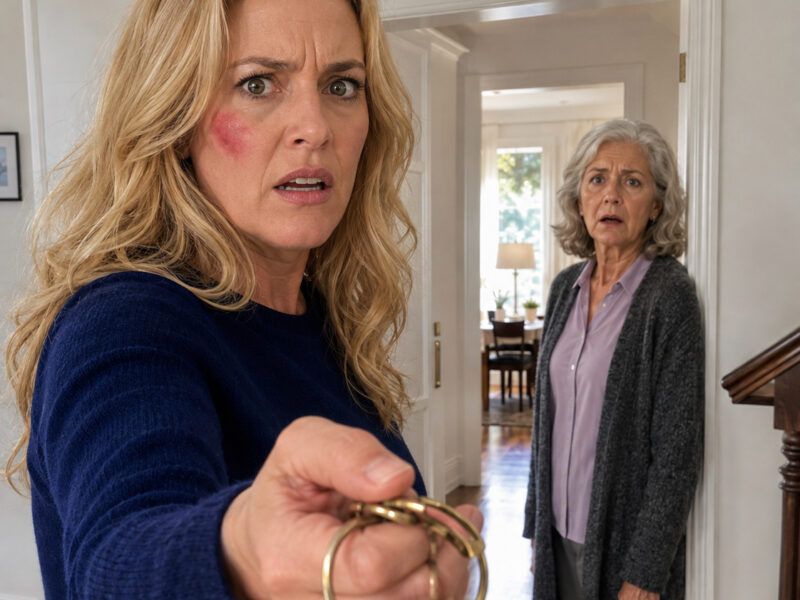
Sitting cross-legged on the rug right beside her was an older woman. She had elegant silver hair pulled into a neat twist, and she was wearing a soft cardigan. She wasn’t panicking. She had one hand resting firmly on Jen’s heaving shoulder, and the other tracking a steady rhythm on the floor.
“Breathe with me, Jen,” the older woman was saying, her voice incredibly low, melodic, and fiercely grounding. “In for four. Hold. Out for four. You are safe here. You are in the office. You are not in the ward. The monitors are off.”
I stood paralyzed in the doorway, my fists still clenched, my brain desperately trying to bridge the gap between a clandestine affair and… this.
The older woman finally looked up at me. Her eyes were sharp, intelligent, and entirely unfazed by my dramatic, violent entrance.
“Jason, I presume?” she asked quietly, not removing her hand from my wife’s shoulder.
“Who… who the hell are you?” I stammered, the anger rapidly draining from my veins, replaced by a cold, sickening confusion. “Where is N?”
“Please, come in and shut the door behind you. You are letting the draft in,” the woman instructed firmly. I obeyed mechanically, the heavy oak door clicking shut, sealing us inside.
“I am Dr. Natasha Reynolds,” the woman said, looking me dead in the eye. “I am a clinical psychiatrist specializing in severe, occupational PTSD. And your wife is currently experiencing a massive, dissociative panic attack.”
The floor beneath my feet felt like it was dissolving.
Natasha.
N wasn’t a lover. N was a doctor. The text message—I know it hurts, but we have to go deeper tomorrow—wasn’t a sick sexual innuendo. It was clinical. It was about trauma therapy.
“Jen?” I whispered, my voice cracking as my knees finally gave out. I dropped to the carpet a few feet away from them.
At the sound of my voice, Jen’s eyes flew open. They were entirely bloodshot, the pupils blown wide with pure, unfiltered terror. But the moment she recognized my face, the terror morphed into something infinitely worse: absolute, crushing shame.
She let out a broken, agonizing wail and tried to scramble backward, pushing herself away from me until her back hit the base of the sofa.
“No, no, no,” Jen wept, hiding her face behind her trembling hands. “You weren’t supposed to see this. You weren’t supposed to know! Leave! Jason, please, leave!”
“She was terrified you would look at her the exact way you are looking right now, Jason,” Dr. Natasha said gently, moving closer to Jen to maintain the physical anchor. “She was terrified you would see her as broken and incapable.”
My hands were shaking violently as I reached into my jacket pocket. I pulled out the crumpled, tear-stained piece of notebook paper Woody had found in the trash.
“But the note,” I choked out, holding the paper toward the doctor like a piece of damning evidence. “Woody found this. She said she couldn’t take it anymore. She said she had to end it today. I thought… God, I thought she was going to hurt herself. Or that she was trapped by someone.”
Dr. Natasha looked at the paper and let out a long, heavy sigh, her expression softening with profound sadness.
“That was a journaling exercise, Jason. A cognitive unburdening,” Dr. Natasha explained softly. “I asked Jen to write down the darkest, most intrusive thoughts she has been battling, so we could externalize them. Put them on paper, then throw them away. ‘Ending it’ didn’t mean ending her life. It meant ending the silence. It meant admitting defeat. It meant quitting her job at the hospital, which, to a woman who has dedicated her entire life to healing people, feels like a death sentence.”
I looked at my wife, shivering on the floor of a psychiatrist’s office, hiding her face in shame, and the immense, crushing weight of my own ignorance slammed into me. I had been hunting for ghosts of infidelity, tearing my own house apart looking for a villain, while the woman I loved was fighting a solitary, bloody war inside her own head.
“I’m so sorry,” I whispered, crawling across the rug toward her. “Jen, I’m so sorry. I thought… the secrecy, the changing clothes in the driveway… I thought you were with someone else.”
Jen peeked through her fingers, her breath hitching painfully in her chest.
“But there’s one thing I don’t understand,” I pleaded, needing the final piece of the nightmare to make sense before I could truly breathe again. I stopped inches from her. “The plastic bag under your car seat. I searched it yesterday, Jen. I found your scrubs.”
I swallowed hard, the metallic taste of fear returning to my mouth.
“There was fresh blood on the collar,” I stated, my voice barely a whisper in the quiet room. “A lot of it. If there is no affair… if there is no dangerous man… then whose blood is hidden in your car?”
The room went deathly silent. Even the white noise machine seemed to fade away.
Jen slowly lowered her hands from her face. She looked at me, and the expression in her eyes was so vacant, so haunted, that it chilled the blood in my veins. It was the “thousand-yard stare” of a soldier who had seen the gates of hell.
“That wasn’t my blood, Jason,” she whispered, her voice completely deadened, stripped of all emotion. “And it wasn’t a lover’s.”
She leaned forward, closing the distance between us, and delivered a truth that would haunt my sleep for the rest of my life.
“That blood belonged to a twelve-year-old boy. And I am the one who had to stop pumping his chest and let him die.”
Chapter 5: The Scent of Rust
I sat on the floor beside her, the anger completely gone, replaced by a devastating, hollow ache.
“The blood in your car,” I asked softly, needing to understand the final piece of the nightmare. “I found fresh blood on your scrubs today, Jen.”
Jen squeezed her eyes shut, fresh tears spilling over her lashes. “It was a twelve-year-old boy,” she choked out, the words tearing out of her throat like jagged glass. “A hit and run. They brought him in during the final hour of my shift. His chest… it was crushed, Jason.”
I felt my stomach drop. Woody was nine.
“We coded him for forty-five minutes,” she sobbed, her whole body shaking. “I was doing chest compressions. I was covered in his blood. And despite everything we did, despite all the machines and the adrenaline, his heart just stopped. I had to stop pumping. I had to let him die.”
She looked at me, and the sheer, unadulterated trauma in her eyes was terrifying.
“Do you know why I change my clothes in the driveway?” she wept. “Do you know why I use that cheap, heavy perfume? It’s not to hide a man. It’s because the smell of the ICU… the smell of a dying child… it tastes like rust. It smells like copper and metallic rot. It gets into my hair. It gets under my fingernails.”
She held up her hands, the hands she had scrubbed raw in her sleep.
“I couldn’t walk into our house, smelling like that boy’s death, and hug Woody,” she cried, her voice echoing off the walls of the therapy room. “I couldn’t let my son smell the blood on his mother. So I sat in the driveway. I cried until I couldn’t breathe. I put on a different shirt, I sprayed that terrible perfume, and I walked inside and pretended I was perfectly fine. Because you and Woody needed me to be strong.”
The realization hit me like a physical blow to the sternum. I had been hunting for ghosts of infidelity while my wife was fighting a solitary war against the trauma of human mortality.
“The nightmares,” I whispered, remembering the sleepwalking.
“I dream about the monitors,” she said, leaning her head against my shoulder as I finally pulled her into my arms. “I hear the alarms every time a car brakes too hard outside our house. Every time your phone rings, I think it’s the hospital calling to say another kid is coming in. I was shattering, Jason. And I was so ashamed that I couldn’t handle the job I was trained to do.”
I held her tightly, burying my face in her hair. “You are not weak, Jen. You are the strongest person I have ever known. But you are never, ever doing this alone again.”
We stayed in Dr. Natasha’s office for another hour. We didn’t solve everything that day. Unearthing buried trauma is a messy, painful excavation. But the silence was broken. The devastating illusions I had built in my head were shattered, replaced by a brutal but honest reality.
We drove home in the fading evening light. When we pulled into the driveway, Jen didn’t reach for her plastic bag. She didn’t reach for the perfume.
She turned off the engine, looked at me, and took a deep, shuddering breath. “Ready?” she asked.
“Together,” I promised.
We walked through the front door. But as we stepped into the foyer, my mother was standing in the kitchen, her face pale, holding Woody’s phone.
“Jason,” my mother said, her voice trembling. “Woody ran away. He left a note saying he needed to find out what was making Mom so sad.”
Chapter 6: The Foundation Rebuilt
The panic that gripped us in that foyer was absolute, an icy, asphyxiating terror that entirely eclipsed the emotional exhaustion of the previous hours. My mother stood trembling by the kitchen island, clutching Woody’s phone like it was a live grenade. The digital note he had left behind was agonizingly brief: I need to find out what is making Mom so sad. I have to fix it.
We sprinted out the front door, the fading evening light suddenly feeling oppressive and menacing. We split up, frantically scouring the suburban streets, screaming his name into the gathering dusk. My mind, so prone to catastrophic narratives, began to conjure horrifying scenarios.
But the sheer panic was remarkably short-lived. I found him twenty minutes later, sitting on the cold wooden bench at Oak Creek Park, just three blocks from our house. He was huddled beneath the amber glow of a solitary sodium streetlight, clutching his knees to his chest, staring blankly at the woodchips beneath his sneakers.
I called Jen, my voice cracking, and within two minutes, her headlights swept across the grass. She didn’t even bother to shut the car door. She sprinted across the lawn, dropping to her knees in the damp dirt, and pulled our son into a fierce, desperate embrace.
“I’m sorry, Mom,” Woody mumbled into her shoulder, his small body trembling. “I just wanted to fix it. I thought… I thought maybe I was doing something wrong. Or maybe if I found out who was hurting you, I could make them stop. I didn’t want you to be sad in the car anymore.”
“Oh, my sweet, beautiful boy,” Jen wept, burying her face in his hair, rocking him back and forth. “It is not your job to fix me. It was never your job. You are the brightest light in my entire world. The sadness has absolutely nothing to do with you.”
That night, the three of us sat on the living room rug. We didn’t sanitize the conversation with empty platitudes, nor did we burden a nine-year-old with the gory, traumatic details of the hospital ward. Instead, we offered him the profound respect of the truth. We explained that Mom’s job involved fighting a war against terrible illnesses, and that sometimes, despite her best efforts, she couldn’t save people. We explained that it left a heavy, invisible weight on her heart, and she had been trying to hide it because she mistakenly believed she had to protect us from the darkness.
“It’s okay to be sad, Mom,” Woody said simply, his young eyes filled with a level of empathy that most adults spend a lifetime trying to cultivate. “You don’t have to hide in the driveway anymore. We can be sad together.”
It has been six months since that terrible, beautiful day. The transformation within our home wasn’t instantaneous—healing from psychological trauma is never a clean, linear trajectory—but it was undeniably profound.
Jen never went back to the ICU. Guided by Dr. Natasha Reynolds, she submitted her transfer papers and moved to the Cardiac Rehabilitation Unit. It is an outpatient facility. No more emergency codes echoing through sterile hallways. No more life support machines violently flatlining. No more carrying the metallic, rusted scent of death into our sanctuary.
The physical changes in her were the first thing I noticed. The terrifying sleepwalking ceased entirely. The intense, full-body flinching whenever a car braked too hard outside our window gradually faded into a manageable, rare occurrence. The color returned to her cheeks, and the hollow, haunted look in her eyes was replaced by the warm, vibrant woman I had fallen in love with a decade ago.
She still has hard days, of course. Days when a specific smell or a passing ambulance triggers the ghost of a memory, rendering her quiet and withdrawn. But she doesn’t hide anymore. She doesn’t retreat to a locked metal box to weep in isolation.
I spent three weekends transforming a cluttered corner of our garage into a dedicated “decompression space.” I ripped out the old shelving, painted the walls a soothing, deep blue, and brought in a plush leather recliner, warm amber lighting, and several broad-leafed potted plants. It smells like fresh pine and potting soil, a stark contrast to the industrial bleach of her past. Now, when she comes home from a particularly draining shift, she sits there for twenty minutes. She listens to soft music, processes the day, and leaves the emotional residue of the clinic behind before opening the door to our kitchen. She isn’t hiding; she is actively, healthily healing.
I often sit in my office and reflect on how terrifyingly close I came to detonating my own family. I had let insecurity, paranoia, and a rigid, cynical logic blind me to the actual agony my wife was enduring. I was so arrogantly certain that I was the victim of a clandestine affair. I had mentally convicted her based on hidden clothes, heavy perfume, and secretive trips to a luxury building. I thought she was a villain in a cheap romance novel, when in reality, she was a casualty of a war she fought every single day to save the lives of strangers.
I have fundamentally changed as a husband. I learned the hard way that marriage isn’t a glossy, static photograph of two people who never struggle. It is the gritty, exhausting, beautiful commitment to struggling together. It’s about looking at the person you love, seeing their hands rubbed raw from invisible stains, and asking, “How can I help you carry this?” instead of jumping to the most selfish conclusion.
We survived the shadows in the driveway. The clandestine plastic bags are gone. The suffocating silence has been broken. Now, when my wife comes home, she walks right through the front door, exactly as she is—flawed, recovering, and entirely loved.
If you want more stories like this, or if you’d like to share your thoughts about what you would have done in my situation, I’d love to hear from you. Your perspective helps these stories reach more people, so don’t be shy about commenting or sharing.