There are some lives that seem impossible when written down on paper. They look less like a biography and more like a movie script — a story too unlikely for anyone to believe. A man who was expected to become a military officer instead became one of the greatest songwriters in American history. A Rhodes Scholar who studied Shakespeare and William Blake became the voice of lonely truck drivers, broken hearts, wandering souls, and people searching for forgiveness. A decorated Army Ranger and helicopter pilot traded his uniform for a pair of worn-out boots and spent years sweeping floors at a recording studio, hoping someone would hear the songs he carried in his head.
That man was Kris Kristofferson.
Before he became a country music legend, before his songs were recorded by Johnny Cash, Janis Joplin, Willie Nelson, and countless others, Kris Kristofferson was a man caught between two worlds. He was born into privilege, discipline, and expectation — but his heart belonged somewhere else. His family believed in duty, achievement, and tradition. Music was not supposed to be his future. Writing songs was not supposed to be a career. Leaving the military was not supposed to be an option.
Yet almost everything extraordinary about Kris Kristofferson came from the moments when he refused to follow the path that had been chosen for him.
His journey was not the story of a man who found success overnight. It was the story of a man who spent years being ignored, rejected, and underestimated. It was the story of someone who risked everything because he believed that a song could matter.
And one afternoon in 1969, when almost nobody in Nashville knew his name, he made the most desperate move of his life.
He climbed into a helicopter.
He flew to Johnny Cash’s property.
And he landed in the backyard of a man who would help change his life forever.
Born Into a World of Expectations
Kris Kristofferson was born Kristoffer Kristofferson on June 22, 1936, in Brownsville, Texas, near the Mexican border. His childhood was shaped by discipline, military tradition, and a strong sense of responsibility.
His father, Lars Henry Kristofferson, was a United States Army Air Corps officer who eventually became a major general. His grandfather had served as an officer in the Swedish Army, and military service was deeply woven into the family identity.
The Kristofferson family believed in achievement.
They believed in sacrifice.
They believed that a person’s duty was to serve something larger than themselves.
From an early age, Kris was expected to continue that tradition. He was intelligent, athletic, and ambitious — exactly the kind of young man his family hoped he would become.
But behind the disciplined exterior was a young man with a different passion.
He loved literature.
He loved poetry.
He loved the power of words.
While many children dream of adventure, Kris found adventure inside books. The works of writers like William Blake, William Shakespeare, and other literary figures shaped the way he saw the world. He became fascinated by the beauty and pain contained in human stories.
That fascination would later become the foundation of his songwriting.
But first, he followed the path everyone expected.
At Pomona College in California, Kristofferson excelled academically while also becoming known as an athlete. He competed as a Golden Gloves boxer, played rugby, and maintained outstanding grades. He was not simply talented in one area — he seemed capable of succeeding anywhere.
In 1958, his achievements earned him one of the most prestigious academic honors in the world.
He received a Rhodes Scholarship.
He traveled to England and studied at Oxford University, where he earned a master’s degree in English literature. During his time there, he studied great writers and even published short stories.
To many people, this would have been the beginning of a brilliant academic career.
A future professor.
A respected scholar.
A man surrounded by books and universities.
But Kris Kristofferson had another voice inside him.
A voice that would eventually lead him far away from the life everyone had planned.
The Soldier Who Wanted to Write Songs
After returning to America, Kris married his college sweetheart and made the decision that seemed inevitable.
He joined the military.
He trained as an Army Ranger and became a helicopter pilot. He served in West Germany and earned the respect expected of someone from his background.
His family was proud.
His future looked secure.
Then came a moment that could have defined his entire life.
The Army offered him a position teaching English literature at the United States Military Academy at West Point.
For most people, this would have been an incredible opportunity.
A stable career.
A respected position.
A chance to combine his love of literature with his military experience.
But Kris Kristofferson looked at the offer and realized something terrifying.
It was not what he wanted.
Deep inside, he wanted to write songs.
He wanted to tell stories.
He wanted to create something that came from his own experiences rather than simply teaching the words of others.
So in 1965, only two weeks before he was scheduled to report to West Point, he made a decision that shocked everyone around him.
He resigned from the Army.
His family was devastated.
To them, he had walked away from honor, security, and success.
His parents could not understand why their highly educated son would throw away such a promising future.
But Kris understood something they did not.
Sometimes the safest road is not the right road.
He packed his belongings and drove to Nashville, Tennessee.
He arrived with dreams, songs, and almost nothing else.
The city that would eventually celebrate him did not welcome him immediately.
In fact, for years, Nashville barely noticed him at all.
The Years Nobody Saw
Today, it is difficult to imagine Kris Kristofferson struggling.
The man who would eventually become a legend once lived a life of uncertainty and rejection.
For more than four years, he was almost invisible.
He worked whatever jobs he could find.
He became a bartender.
He worked construction.
He took jobs connected to the railroad.
He did whatever was necessary to survive.
But his most famous job was perhaps the most humbling.
He became a janitor at Columbia Records in Nashville.
Every day, he swept floors.
He emptied ashtrays.
He cleaned the same building where some of the most important musicians in the world were creating history.
Inside those studios, artists were recording songs that would define generations.
And Kris Kristofferson was cleaning up after them.
One of the people he regularly saw was Johnny Cash.
At that time, Cash was already a superstar.
He was famous.
He was respected.
He was exactly the kind of person Kris hoped would listen to his songs.
Kristofferson tried to get his music into Cash’s hands.
He gave him tapes.
He tried to get his attention.
But success was not waiting around the corner.
According to the famous story, Cash took some of Kristofferson’s demos home but eventually threw many of them into the lake near his property.
The songs were ignored.
The dream seemed impossible.
But Kris did not quit.
During the week, he worked.
On weekends, he continued writing.
He also worked as a helicopter pilot, flying missions connected to oil platforms in the Gulf of Mexico.
Those flights became some of the most important moments of his creative life.
High above the ocean, surrounded by endless sky, he wrote songs about loneliness, regret, love, and survival.
The people he saw — workers risking their lives far from home — became part of his songwriting.
He understood ordinary people because he had lived among them.
He was not writing from a mansion.
He was writing from exhaustion.
From failure.
From experience.
And that honesty would eventually make him one of the greatest songwriters in history.
The Helicopter Landing That Changed Everything
By 1969, Kris Kristofferson was approaching his mid-30s.
His marriage had ended.
His family still questioned his choices.
His music career was going nowhere.
He had spent years chasing a dream that seemed determined to reject him.
Most people would have given up.
But Kris Kristofferson was different.
He had already sacrificed too much to turn back.
Then came the moment that became part of music history.
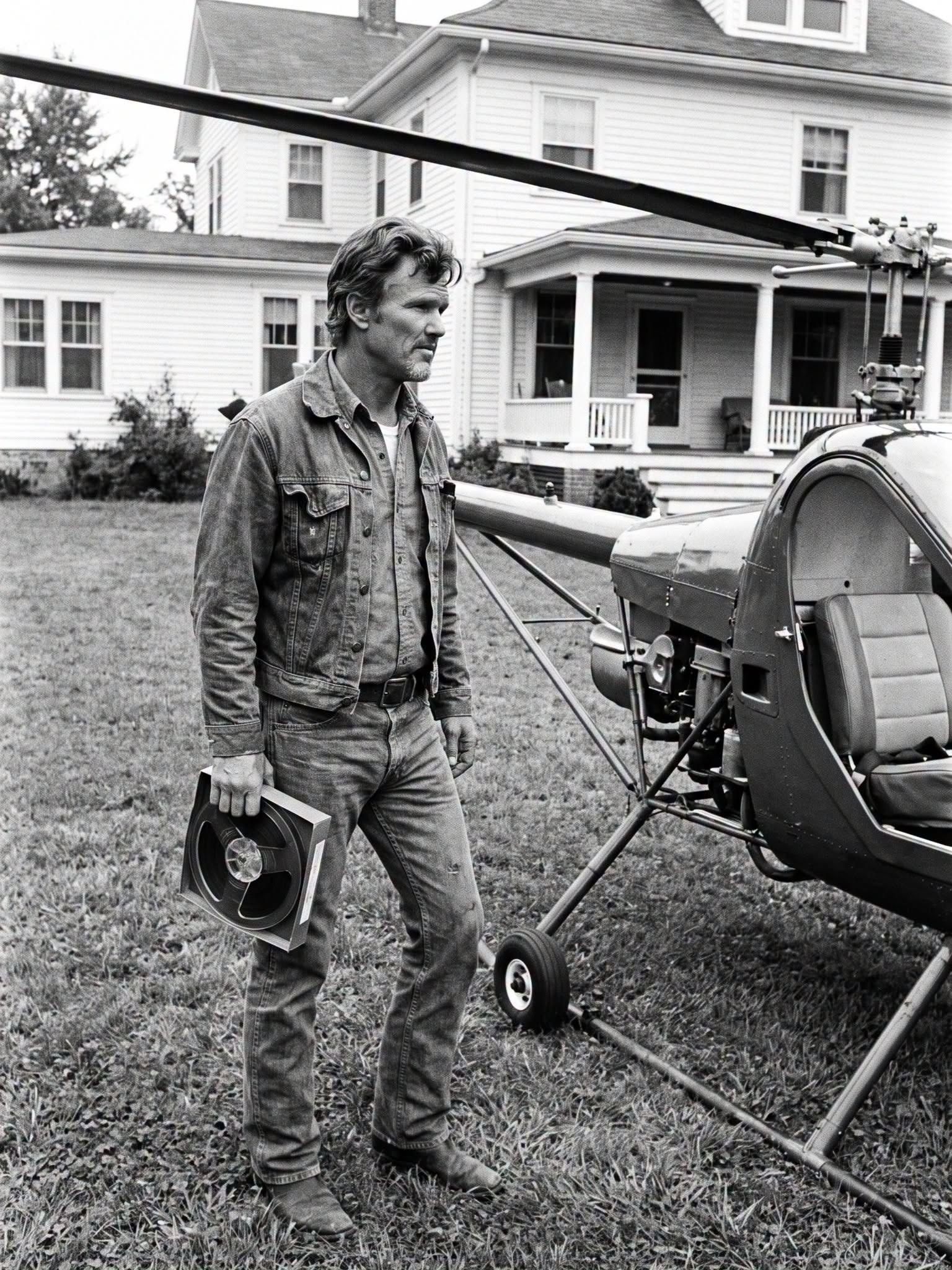
While working as a helicopter pilot, Kristofferson decided to take an extraordinary risk.
He flew to Johnny Cash’s property in Hendersonville, Tennessee.
And he landed the helicopter in Cash’s backyard.
The image was almost unbelievable.
A struggling songwriter, arriving from the sky, carrying his music directly to one of the biggest stars in country music.
Johnny Cash’s wife, June Carter Cash, reportedly looked outside and joked that people used to come to the house by road, but now they were arriving from the sky.
Whether Cash was home at that exact moment or not, the message was clear.
Kris Kristofferson was impossible to ignore.
Finally, Johnny Cash listened.
And when he heard the songs, everything changed.
One of those songs was “Sunday Morning Coming Down.”
It was unlike anything else being played at the time.
It was not a simple love song.
It was not a celebration.
It was a brutally honest portrait of loneliness.
The song described a person waking up after a difficult night, feeling empty, lost, and searching for meaning.
Johnny Cash recorded it in 1970.
It became a massive success.
The song reached number one on the country charts.
Suddenly, the man who had spent years sweeping floors was being recognized as one of the greatest songwriters in America.
When Cash performed the song on television, executives wanted him to change one lyric.
They objected to the word “stoned.”
Cash refused.
He believed in the song.
He believed in Kristofferson’s honesty.
So he performed it exactly as written.
That moment represented everything Kris Kristofferson stood for.
Truth mattered more than approval.
The Songs That Defined a Generation
The success of “Sunday Morning Coming Down” was only the beginning.
In 1971, Kris Kristofferson’s songwriting reached another level when Janis Joplin recorded “Me and Bobby McGee.”
The song became one of the biggest hits of her career.
It reached number one on the Billboard Hot 100 after her death.
Joplin had died in October 1970, shortly before the song’s release.
Kristofferson and Joplin had shared a close relationship, and hearing her voice on the song was emotionally overwhelming for him.
He later said he struggled to listen to the recording because of the memories attached to it.
That same year, Sammi Smith recorded Kristofferson’s “Help Me Make It Through the Night.”
The song became a major hit and earned Grammy recognition.
Suddenly, the songwriter who had once been ignored had created some of the most important songs in American music.
His success was remarkable because he did not write about fantasy.
He wrote about real life.
Loneliness.
Mistakes.
Desire.
Regret.
Hope.
His characters were not perfect people.
They were people trying to survive.
That was why millions connected with his music.
From Songwriter to Hollywood Star and Country Icon
Kris Kristofferson did not stop with songwriting.
He moved into acting and built another successful career.
He appeared in more than 50 films and became known for roles that reflected the same authenticity found in his music.
His performance in “A Star Is Born” alongside Barbra Streisand earned him a Golden Globe Award in 1976.
He became part of the legendary country supergroup The Highwaymen alongside Johnny Cash, Willie Nelson, and Waylon Jennings.
Together, they represented a generation of artists who valued independence and honesty over industry expectations.
Kristofferson was inducted into the Songwriters Hall of Fame in 1985.
In 2004, he received one of country music’s highest honors when he entered the Country Music Hall of Fame.
But perhaps his greatest achievement was not the awards.
It was the fact that he remained true to himself.
He never became the person others wanted him to be.
He became the person he always believed he could become.
The Final Chapter of an Unforgettable Life
Kris Kristofferson passed away peacefully at his home on September 28, 2024, at the age of 88.
The man who once arrived in Nashville with nothing but a dream left behind one of the greatest musical legacies in American history.
He had been a scholar.
A soldier.
A pilot.
A janitor.
A songwriter.
An actor.
A legend.
His life proved that success does not always arrive when people expect it.
Sometimes it comes after years of rejection.
Sometimes it comes after everyone tells you that you are making the wrong choice.
Sometimes it comes when you are standing alone, holding onto something that nobody else can see.
Kris Kristofferson spent years being told that his dream was unrealistic.
He proved them wrong.
He showed that a person can change their entire life with courage, persistence, and belief.
The family statement after his passing included a simple message:
“When you see a rainbow, know he’s smiling down on us all.”
And perhaps that is the perfect ending for a man who spent his life writing about storms, searching for light, and reminding people that even the most broken roads can lead somewhere beautiful.