The stagecoach reached Silver Ridge under a hard white sun, with dust hanging behind it like smoke from a bad fire.
It should have slowed at the stop, but it came in rough, wheels grinding, horses lathered, driver stiff with the impatience of a man who wanted distance more than payment.
The door flew open before the coach had fully settled.
A small valise hit the ground first.
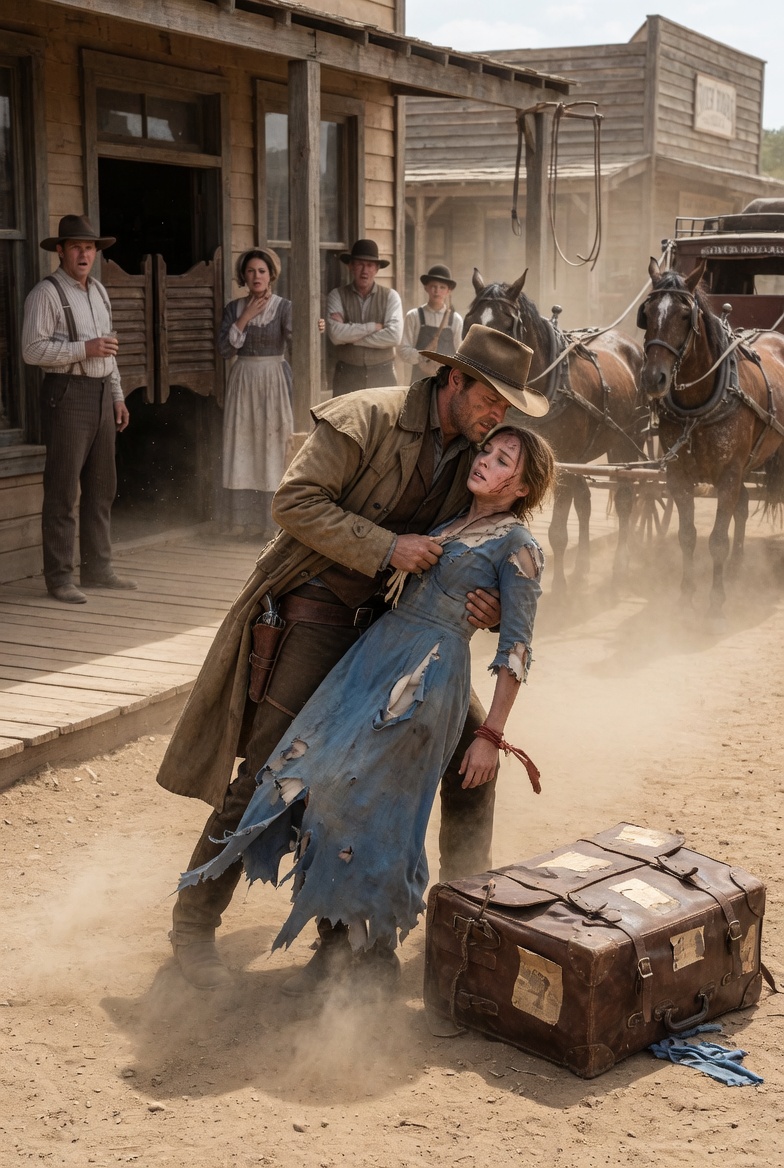
Then a woman fell after it.
She struck the road in front of the saloon and did not get up.
For one long breath, the whole town seemed to listen to the sound her body made in the dust.
A tin cup stopped near a man’s mouth.
A storekeeper leaned out of the general store and then leaned back again, as if his own doorway might protect him from having seen too much.
The stagecoach driver snapped the reins, and the horses dragged the coach out of town in a dirty rush.
No one called him back.
No one asked what right he had.
Folks on the frontier could make a religion out of minding their own business when trouble wore blood on its face.
Caleb Boone stood by the hitching rail, one boot hooked against the post, his hat pulled low against the glare.
He had come into town for coffee, nails, and a sack of feed.
He forgot all three the moment the woman moved.
She pressed her palms into the dirt and tried to rise.
Her arms shook so badly that dust slipped between her fingers.
She made it halfway to her knees before pain folded her down again, and the sound that left her throat was small enough to shame every man who heard it.
Still, nobody stepped forward.
The woman’s dress had once been blue, maybe neat, maybe even pretty before the road and cruelty got hold of it.
Now the hem was torn, one sleeve hung loose, and the fabric at her side pulled sharp each time she tried to breathe.
Her cheek was swollen.
Dried blood darkened her temple.
Around both wrists were marks that did not come from a fall.
Caleb pushed away from the hitching rail.
His hand went near his holster out of habit, then stopped.
There was no man in front of him to shoot.
Only the work of one.
He crossed the road with care, not because he feared the town, but because the woman flinched at every sound.
His spurs gave one soft scrape against the hard-packed dirt.
She heard it and lifted a trembling hand over her face.
That was the thing that settled it in him.
Not the blood.
Not the torn dress.
The hand.
A person did not learn that motion from one bad hour.
A person learned it from expecting pain before it arrived.
“Easy,” Caleb said.
His voice came low and steady, the way a man might speak to a frightened mare in a storm.
She stared at him through dust and fear, breathing as if each breath had to cross broken glass.
“I’m not going to hurt you.”
She did not answer.
Maybe she could not.
Maybe words had become too dangerous to spend on strangers.
Caleb crouched beside her and saw the way she tried to pull away even though her body had no strength left for it.
He should have asked permission.
A decent man would have asked.
But she was shaking so hard the dirt beneath her hands trembled, and another minute in that street would have been another kind of cruelty.
So Caleb slid one arm beneath her knees and the other behind her shoulders.
He lifted her with the careful strength of a man picking up something already cracked.
She went stiff in his arms.
Her eyes squeezed shut, waiting for roughness, waiting for a grip that punished, waiting for the next pain to prove the world had not changed.
None came.
Caleb held her close enough to keep her from falling and loose enough not to trap her.
Her head turned against his coat.
He could feel her breath catch.
Then, slowly, her fingers closed weakly in the front of his shirt.
The street had gone quiet.
The saloon doors creaked once in the wind.
A horse stamped near the rail.
Caleb looked straight ahead, not at the cowards watching from under brims and awnings.
“No one will hurt you again,” he said.
He said it quietly.
That made it worse for the men who heard.
A loud promise could be vanity.
A quiet one had weight.
He carried her down the street toward Doc Mercer’s office while the whole town watched what it had not been brave enough to do.
Doc Mercer had a narrow place at the end of the row, with a cracked window, a shelf of brown bottles, and a table worn smooth by worry.
He looked up ready to complain until he saw the woman in Caleb’s arms.
His mouth closed.
“Put her here,” he said, clearing the table with one sweep of his arm.
Caleb laid her down as gently as he could.
The woman bit the inside of her cheek to keep from crying out, and that told Doc Mercer plenty before he touched a single bruise.
The office smelled of old wood, boiled cloth, bitter tonic, and the sharp sting of medicine.
Caleb moved back only far enough to give the doctor room.
He did not leave the door.
Doc Mercer checked her ribs, her wrists, the cut at her temple, and the dark bruises that ran beneath what remained of her dress.
He worked with a careful face, but his jaw tightened.
“Three ribs cracked, maybe more if she moves foolish,” he said.
The woman opened her eyes.
“I’m fine.”
“No,” Doc Mercer said. “You’re alive. That is not the same thing.”
Caleb watched her turn away from both of them, as if even kindness had edges sharp enough to cut.
The doctor wrapped her ribs and gave her water in small sips.
She drank like someone afraid the cup might be taken back.
When he asked her name, she waited so long Caleb thought she might refuse.
“Eliza Hale,” she whispered.
Her voice was cracked from dust and thirst.
When Doc Mercer asked who had done this, all the breath seemed to leave the room.
Eliza stared at the wall.
“It doesn’t matter.”
Caleb stepped closer.
He did not raise his voice.
“It matters.”
She looked at him then, really looked, studying the sun-dark lines in his face, the broad shoulders, the worn coat, the eyes that seemed too tired for lies.
“A man I trusted,” she said.
After that, her eyes closed as if the words had cost more than blood.
Doc Mercer gave Caleb a look that carried both warning and knowledge.
“She can’t travel,” he said. “She can’t be left alone. Boarding house is full.”
Caleb did not ask what the town owed her.
He already knew the answer.
Less than it should.
“She’ll come with me,” he said.
Eliza’s eyes opened again.
Fear moved through them, quick and bright.
Caleb saw it and did not blame her.
A man’s roof could mean shelter.
It could also mean ownership, if the man was wicked enough and the world looked away.
“You’ll have your own room,” he said. “A door. Food. Fire. No debt.”
Eliza studied him like a woman trying to read a contract written in smoke.
Doc Mercer capped the tonic bottle and set it beside her.
“Boone keeps his word,” the doctor said.
That was not enough to make her trust.
But exhaustion did what trust could not.
By late afternoon, Caleb carried her to his wagon.
The same people who had ignored her in the road now watched him tuck a quilt around her shoulders and place her valise beneath the seat.
No one offered help.
No one asked her story.
Shame stood in the street with them, but it did not move their feet.
The wagon left Silver Ridge with the sun lowering behind the roofs and the road turning copper beneath the wheels.
Eliza drifted in and out of waking.
She caught pieces of the world in fragments.
Leather creaking.
Horses breathing.
Caleb’s hand steady on the reins.
The smell of dust, pine smoke, and the bitter medicine Doc Mercer had forced on her.
Sometimes the wagon hit a rut and pain tore her awake.
Each time, Caleb slowed without looking back to make a show of it.
“Almost there,” he would say.
Or, “You’re safe for now.”
For now was the only honest kind of safety the frontier could offer.
His ranch sat beyond the town’s last dust line, tucked against low hills where the wind came colder after sundown.
It was not grand.
A cabin, a barn, a corral, a woodpile, a few cattle moving dark against the grass, and a porch that faced the long road from Silver Ridge.
To Eliza, it looked impossible.
A roof with no shouting under it.
A door that might close.
A bed not bargained for with pain.
Caleb carried her inside and set her in the back room.
There was a quilt on the bed, a washbasin on the small table, and an oil lamp trimmed low enough not to sting her eyes.
He placed her valise by the chair.
Then he stepped back.
“I’ll be in the front room,” he said. “You need anything, call.”
She expected him to linger.
He did not.
That was the first decent thing.

The next morning, there was coffee on the stove, bread on a plate, water by her bed, and firewood stacked near enough that she could see he had planned for her weakness without making her speak of it.
He knocked before entering.
Every time.
He kept his eyes where they belonged.
When he helped her sit, he asked first.
When she could not answer because pain stole her breath, he waited.
Days passed that way, slow and tender without either of them naming tenderness.
Eliza learned the cabin sounds.
The stove ticking as it cooled.
The barn door thudding in wind.
Caleb’s boots on the porch before dawn.
The scrape of a knife against a whetstone at night, not threatening, just practical.
Caleb learned her silences.
The silence that meant pain.
The silence that meant fear.
The silence that meant she was listening to make sure no strange rider had come into the yard.
Trust did not arrive like sunrise.
It came like thaw through frozen ground, first too small to notice, then impossible to deny.
On the fourth morning, Eliza made it to the porch.
She leaned hard on the rail, sweat bright on her upper lip though the air was cool.
The pasture opened before her in rough gold and gray.
Cattle moved with their heads down.
The hills sat blue in the distance.
Smoke from the cabin chimney flattened in the wind.
Caleb found her there and stopped before he got too close.
That pause mattered.
A cruel man would have taken her being outside as permission.
Caleb gave her the choice to send him away.
“I needed to remember the world is still this,” she said.
He looked out over the land with her.
“It is,” he said. “Some mornings.”
She almost smiled.
Almost was enough.
That night, the truth began to come out in pieces.
They sat at the small table with the oil lamp between them, and Eliza turned a tin cup in her hands until her fingers stopped shaking.
The man who had hurt her was not merely cruel.
Cruelty was personal.
What he belonged to was organized enough to be colder than that.
Men moved from town to town, taking money, labor, silence, and fear from people who had no power to defend themselves.
They knew who could be threatened.
They knew who would not be believed.
They kept a ledger.
Eliza had seen it.
Names.
Payments.
Marks beside certain pages she did not understand at first.
Then she understood enough to become dangerous.
“I was supposed to keep quiet,” she said.
Caleb listened without interrupting.
The lamp flame moved in his eyes.
“When I wouldn’t, he said no one would come looking for me.”
Caleb’s hand rested on the table, still and open.
“He was wrong.”
She wanted to believe him again.
Wanting frightened her.
Wanting meant there was something left in her that could be broken.
The next two nights, Caleb slept little.
He told himself it was ordinary caution.
It was not.
He kept his rifle close and watched the dark beyond the corral, listening to cattle shift, coyotes call, and wind run its fingers along the barn boards.
A man can leave his past behind, but he cannot always leave behind the skills it taught him.
Caleb had been trying for years to be quieter than he once was.
Eliza’s arrival had not made him violent again.
It had reminded him that restraint was not the same as surrender.
Before dawn on the third morning, he found the message.
One of his cattle lay dead near the fence line.
No meat taken.
No sign of hunger.
Just waste, staged where he would see it.
Tied to the fence post was a strip of blue cloth.
It moved in the wind like a small torn flag of warning.
Caleb did not touch it right away.
He looked at the ground first.
Tracks.
One horse, maybe two standing back.
Careful riders.
Men who wanted him to know they had come close and could come closer.
Only then did he untie the cloth.
It matched Eliza’s dress.
When he walked back to the cabin, she knew before he spoke.
She was sitting up in bed with both hands gripping the quilt, her face drained white.
“They found me,” she said.
Caleb set the cloth on the table.
“They found the ranch,” he answered. “That isn’t the same thing.”
She tried to stand.
Pain bent her at once, but panic gave her a strength healing had not.
“I need to leave.”
“No.”
“This is my trouble.”
Caleb’s voice did not rise.
“You were thrown into my street. Carried into my doctor’s office. Brought under my roof. That makes it mine enough.”
She shook her head, breathing too fast.
“You don’t know what they are.”
“I know what men are when they think nobody will stop them.”
The answer silenced her.
Outside, the morning wind dragged dust along the yard.
Inside, the oil lamp made small light against a large fear.
Eliza sat back slowly, one hand pressed to her ribs, the other closed around the edge of the quilt.
“I can’t have more blood on me,” she whispered.
Caleb looked at the torn cloth on the table.
Then he looked at her.
“It isn’t on you.”
That day, Doc Mercer came out from Silver Ridge to check her ribs and found the ranch changed.
Caleb had moved a water barrel near the cabin wall.
The horses were kept saddled longer than usual.
A shotgun rested above the door instead of in the corner.
The doctor said little while he worked, but he noticed everything.
When he saw the cloth, his face went grim.
“They won’t stop because you ask,” he told Caleb.
“I wasn’t planning to ask.”
Eliza heard that from the bedroom and closed her eyes.
Fear was still there.
So was something else.
Anger, maybe.
Not the hot kind that made people foolish, but the colder kind that kept a person alive one more day.
That evening, Caleb brought in the valise from under her bed.
“You want this close?” he asked.
Eliza nodded.
He set it on the chair and turned to leave, but she stopped him.
“There’s nothing valuable in it.”
Caleb glanced back.
“Didn’t ask.”
“I mean it,” she said. “A dress. A comb. A letter I never sent. That’s all.”
“Sometimes that’s enough.”
She looked at the valise for a long while.
Then she said, “I thought if I kept one thing that was mine, I’d still be a person.”
Caleb’s face softened in a way she had not seen before.
“You are.”
A simple sentence.
A hard one to believe.
The following evening, the riders came.
They did not charge the ranch.
They did not shout.
They appeared on the ridge beyond the pasture, black shapes against a red sky, sitting their horses with the stillness of men who wanted to be seen.
Caleb stood by the fence with the rifle in his hands.
He counted them.
Eliza stepped onto the porch behind him despite the pain it cost.
The wind caught her hair and pulled it across her bruised cheek.
Her fingers locked around the doorframe.
One of the riders sat a little forward from the rest.
Even at that distance, even with sunset burning behind him, Eliza knew the shape of him.
The set of his shoulders.
The patience of his cruelty.
“That’s him,” she whispered.

Caleb did not turn.
But the air around him changed.
A man could stand quietly and still become dangerous.
The riders watched.
Caleb watched back.
Between them, the pasture lay open and silent.
No one fired.
No one needed to.
The threat had already been delivered.
At last, the lead rider turned his horse and disappeared over the ridge.
The others followed.
The sun dropped, and the ranch fell into a dark that felt newly occupied.
Caleb stayed at the fence long after they were gone.
Eliza came down from the porch one painful step at a time.
“You should send me away,” she said.
“No.”
“You made a promise before you knew what it meant.”
Caleb finally looked at her.
“A promise is worth less if it only holds when the cost is small.”
That sentence stayed with her.
It sat in the cabin that night while Caleb kept watch and Eliza lay awake listening to the dark.
Sometime before dawn, she stopped praying to be hidden and began praying to be brave.
By morning, she asked for paper.
Caleb gave her a scrap from an old account sheet and the stub of a pencil.
She began writing down what she remembered from the ledger.
Not all of it.
Her memory had holes where pain and fear had burned through.
But some marks remained.
A column here.
A name there.
A number beside a payment.
A place in the sequence where one page had been folded, as if the men returned to it often.
Caleb did not pretend to understand every part.
He understood enough.
Evidence mattered.
So did witnesses.
So did staying alive long enough to use both.
Doc Mercer returned that afternoon and found Eliza at the table, pale and sweating, but upright.
He tried to order her back to bed.
She refused with the first clean strength he had heard from her.
“I was quiet once,” she said. “It didn’t save me.”
The doctor looked at Caleb.
Caleb only shrugged.
“She’s got a point.”
For the first time, Eliza laughed.
It was small and rough, gone almost as soon as it came.
But it changed the room.
It told them something had survived.
The men came closer the next night.
A horse moved beyond the barn.
A board creaked where no board should have creaked.
Caleb stepped out with the rifle while Eliza stood inside the doorway, one hand braced against the frame, the other gripping the small table knife because it was the only blade within reach.
A voice from the dark called her name.
Not loudly.
Softly.
That was worse.
It carried ownership.
“Eliza.”
Her body remembered before her mind could stop it.
She flinched.
Caleb saw.
The rifle came up.
“Say her name again,” he called, “and it’ll be the last useful thing your mouth does.”
Silence followed.
Then a laugh from the dark.
A match flared near the barn, one small orange eye opening in the night.
Someone had come with fire.
Caleb moved before the flame touched anything dry.
The shot he fired did not aim for flesh.
It struck the post above the match and showered the ground with splinters.
The flame vanished.
Horses broke into motion.
Men cursed.
Hooves tore away into the dark.
Eliza sagged against the doorframe, not from weakness alone, but from the sick knowledge that the man who had hurt her had stood close enough to speak.
Caleb came back only after he checked the barn, the corral, and the shadows behind the woodpile.
She was still standing with the table knife in her hand.
Her fingers were white around it.
“You can put that down,” he said gently.
She looked at the knife as if surprised to find it there.
Then she lowered it.
“I hate that I was afraid.”
Caleb leaned the rifle by the door.
“Fear kept you alive.”
“I don’t want to only be alive.”
He had no quick answer for that.
Quick answers insulted wounds that deep.
So he set the coffee pot on the stove and stayed with her until her hands stopped shaking.
By sunrise, they both understood the ranch would not stay safe.
The men hunting her had tested the fence, the barn, and Caleb’s nerve.
Soon they would test more.
Eliza knew where they might go.
She had heard enough during the days she was trapped among them to remember an abandoned mining place beyond the hills, a broken town with empty buildings and a road no honest traveler used anymore.
Caleb listened.
He did not like it.
That did not make it less useful.
“They’ll expect you to hide,” he said.
“They expect me to run,” she answered.
“And you want to do neither.”
She looked down at her bruised wrists.
The marks had begun to fade at the edges.
She hated that part of her was glad.
She hated more that another part of her feared fading would make people forget.
“I want it finished,” she said.
Caleb looked toward the ridge where the riders had shown themselves.
“This ends when we end it.”
The words should have frightened her.
They did.
But fear no longer stood alone.
Beside it was anger, and beside anger was the fragile beginning of resolve.
Eliza straightened as much as her ribs allowed.
“Then we end it.”
They rode before dawn two days later, not as fugitives and not as heroes, but as two people who had run out of road behind them.
Caleb saddled the horses in silence.
Eliza wore the least torn dress she owned beneath Caleb’s spare coat, and the valise was tied behind her saddle because she refused to leave the last of herself behind.
Doc Mercer met them at the edge of the yard.
He did not approve.
He also did not try to stop them.
He handed Eliza fresh bandages and Caleb a small bottle of tonic.
“Try not to make my work pointless,” he said.
Eliza managed a tired smile.
“I’ll try.”
The road into the hills was narrow and mean.
Dust rose under the horses’ hooves.
Pine smoke from some distant camp drifted thin across the morning.
Every sound seemed louder than it should have been.
Leather creaked.
A loose buckle tapped.
Caleb’s rifle shifted in its scabbard.
Eliza rode beside him, pale but upright.
At first, Caleb wanted to tell her she could turn back.
He did not.
Some choices, once earned, were not kindness to take away.
The abandoned mining town waited in a hollow between two ridges.
The buildings leaned like tired men.
One sign hung crooked over a doorway, its letters bleached by sun and weather.
Windows stared empty.
Wind moved through gaps in the boards with a dry whisper.
Eliza stopped at the edge of the street.
Caleb saw the memory pass over her face.
Pain had many forms.
Some lived in the body.
Some waited in places.
“That one,” she said, pointing toward a long low building with a broken porch. “I heard them talk there.”

Caleb dismounted first.
He helped her down because her ribs would not allow pride to do everything.
She accepted his hand without flinching.
Neither of them spoke of it.
Inside the building, dust lay thick on the floor except where recent boots had disturbed it.
Caleb crouched and touched one track.
Fresh enough.
Eliza moved toward a corner where an old table stood beneath a cracked window.
Her breathing changed.
“The ledger was there,” she said.
The table was empty.
Of course it was.
Men like that did not leave proof waiting out of courtesy.
But beneath the table, caught between two floorboards, was a torn thread of dark cloth and a sliver of paper folded almost to nothing.
Eliza saw it first.
She reached down slowly, every movement hurting.
The paper came free with a dry whisper.
Only a few marks remained on it.
Not enough for a judge by itself, maybe.
Enough to prove she had not imagined the ledger.
Enough to prove the past had left a corner behind.
Then the wind outside stopped sounding like wind.
Caleb raised his hand.
Eliza froze.
A horse snorted near the far end of the street.
Another answered from behind them.
They had been followed, or expected, or both.
Caleb moved between Eliza and the door.
She hated how natural that was for him.
She loved it too, in a way that scared her more than the riders.
A voice called from outside.
“Eliza, come on out.”
Her fingers closed around the paper.
Caleb looked back once.
Not to ask whether she was afraid.
Only to make sure she was still standing.
She was.
The first shot cracked through the building and tore splinters from the wall near Caleb’s shoulder.
He shoved Eliza down behind the table and returned fire through the window.
The empty town woke all at once.
Gunfire slapped from wall to wall.
Horses screamed.
Dust jumped from the floorboards.
Caleb moved with a precision that did not belong to the quiet rancher who knocked before entering sickrooms.
This was the man he had tried to bury.
Not cruel.
Not wild.
But capable.
Eliza watched him and understood that his promise in the street had not been pretty words.
It had been a door opening on a part of himself he would rather never use again.
A man came around the side window.
Eliza saw the shadow before Caleb did.
“Behind you!” she shouted.
Caleb turned in time.
The shot that might have taken him struck the doorframe instead.
Eliza crawled toward the fallen rifle the attacker had dropped outside the window, ignoring the pain that tore through her ribs.
She could not lift it properly.
She did not need to.
She shoved it out of reach with both hands, denying the next man a weapon.
Small courage mattered.
Sometimes it mattered more than grand courage because it came from someone who had every reason to stay down.
The fight moved fast after that.
Men who had counted on fear found resistance.
Men who had counted on silence heard Eliza’s voice.
She shouted what she remembered.
She named the ledger.
She named the payments.
She named the man who had said no one would come looking.
Every word cracked something open.
At last, the lead rider stepped into the street.
He was close enough now for Caleb to see his face and for Eliza to feel the old terror try to climb her bones.
The man smiled at her as if nothing had changed.
As if bruises were signatures.
As if the road, the stagecoach, the dust, and every hurt between then and now still belonged to him.
“Eliza,” he said. “You’ve caused a great deal of trouble.”
Caleb moved, but Eliza touched his sleeve.
Not to stop him from protecting her.
To stand beside him while he did.
She stepped into the doorway with the torn piece of paper in her fist and the sunlight harsh on her face.
Her body shook.
Her voice did not.
“You should never have touched me.”
For the first time, the man’s smile changed.
He reached for his gun.
Caleb was faster.
The shot ended the motion before the past could take another breath.
Silence came down hard.
Not peaceful.
Earned.
Eliza stood in it with Caleb beside her, the paper crushed in her hand, her eyes open and clear.
She had not been made whole by a gunshot.
Stories lied when they made healing that simple.
But something had been broken that needed breaking.
The men who remained did not look so large without her fear holding them up.
By the time Doc Mercer and riders from Silver Ridge reached the abandoned town, the worst of it was over.
The doctor found Eliza sitting on the broken porch, one arm wrapped around her ribs, the battered valise at her feet.
Caleb stood nearby, watching the road.
“You are determined to undo every bandage I own,” Doc Mercer said.
Eliza looked up at him.
“I’m still alive.”
This time, the doctor did not correct her.
They returned to Silver Ridge under a sky washed clean by wind.
The town that had watched her fall now watched her ride in upright.
Nobody mistook the difference.
The saloon men grew quiet.
The storekeeper came out to the doorway and took off his hat.
Shame had found them at last, late but not useless.
Eliza did not look away from them.
That was its own victory.
In the days that followed, there were questions, papers, statements, and more hard hours than anyone wanted.
The torn ledger scrap did not tell the whole story, but it opened the door to the rest.
Doc Mercer spoke for what he had seen.
Caleb spoke for what he had found.
Eliza spoke for herself.
That mattered most.
She stayed at the ranch while her ribs healed, then stayed because healing had become more than bones mending.
She learned where Caleb kept coffee.
She learned which hinge complained before rain.
She learned that the mare with the white blaze liked apples but hated sudden hands.
Caleb learned that Eliza sang under her breath when she mended, that she took her coffee bitter, and that she could stare down a room full of men once she remembered she had survived worse than their judgment.
They did not fall into easy romance.
Nothing about them was easy.
Trust took work.
So did peace.
Some nights, Eliza woke shaking.
Some mornings, Caleb stood too long at the fence, looking toward the ridge as if the past might grow hooves and return.
But there was bread on the table.
There was fire in the stove.
There were two cups instead of one.
One evening, weeks after Silver Ridge had begun to speak her name with respect instead of pity, Eliza stood beside Caleb on the porch.
The sun had dropped low enough to turn the pasture gold.
Wind moved through the grass.
The road to town lay quiet.
She looked at him for a long time before asking the question that had been waiting since the day he lifted her from the dust.
“That first day,” she said. “When you said no one would hurt me again. Did you mean it?”
Caleb did not smile to soften the answer.
He did not make a speech.
He looked at her the way he had looked at the road ahead while carrying her through Silver Ridge, steady and without show.
“I meant every word.”
This time, Eliza believed him.
Not because the world had become safe.
It had not.
Not because pain had vanished.
It had not.
She believed him because a promise had been tested by dust, blood, fire, fear, and the long road back to herself.
And it had held.