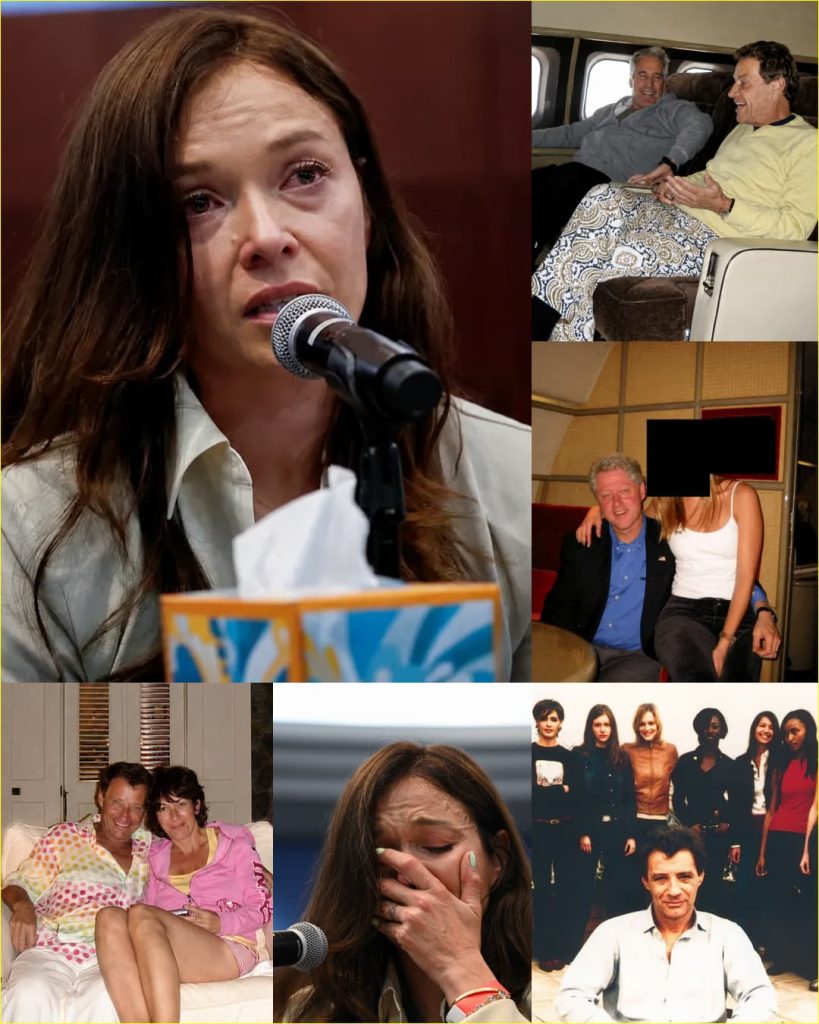
On May 12 in Florida, what was once presented as a glamorous doorway into the international modeling world turned into a devastating public account of fear, control, and betrayal. Roza, a woman whose name is now tied to one of the darkest chapters surrounding Jeffrey Epstein and Jean-Luc Brunel, stepped forward with a testimony that cut far deeper than a single personal tragedy.
“They promised me a runway,” she said, “but they put me in a glass cage.”
That sentence became the emotional center of the hearing in Palm Beach. It was not only a description of broken promises. It was a symbol of an entire system that, according to survivor accounts and newly discussed records, allegedly used beauty, ambition, money, and silence as tools of exploitation.
Roza described how a dream of becoming a model slowly became a trap. What began with international opportunities, polished contracts, and promises of access to elite fashion circles allegedly turned into isolation, surveillance, and psychological control. The language of opportunity hid the mechanics of captivity. The dream sold to her was freedom. The reality, she said, was fear.

At the center of the discussion was the newly referenced report, The Price of Non-Prosecution, which has intensified public scrutiny over how powerful figures may have avoided consequences for years. The report does not merely revisit old accusations. It raises a larger and more disturbing question: how could a network linked to Epstein survive for so long while victims repeatedly tried to speak?
The answer, according to the allegations surrounding the case, may lie in a combination of wealth, legal protection, institutional failure, and carefully managed silence.
For Roza, the modeling world was allegedly used as bait. Jean-Luc Brunel, long associated with the fashion industry and later accused by multiple women of helping recruit young girls for Epstein’s circle, represents one of the most chilling overlaps between glamour and abuse. In that world, an invitation could look like a career opportunity. A plane ticket could look like success. A private meeting could be framed as mentorship.
But behind the polished surface, Roza’s account suggests a darker machinery: young women moved across borders, placed near powerful men, and then made to feel that no one would believe them if they tried to escape.
The most disturbing part of Roza’s testimony was not only what she said happened to her. It was the implication that her experience was not isolated. She described a network, not a single predator. She spoke of men who operated behind reputations, financial influence, and social status. These were not strangers hiding in alleys. They were people allegedly protected by proximity to wealth and power.
That is why the Florida hearing felt less like a courtroom moment and more like a rupture in a long-sealed wall.
The report’s title, The Price of Non-Prosecution, points directly to the central accusation: that the failure to fully prosecute Epstein earlier did not merely delay justice. It may have allowed more harm to continue. A legal decision made behind closed doors can become, for victims, a life sentence. When powerful people are not held accountable, survivors are often forced to carry the consequences alone.
Roza’s story also exposes another frightening issue: the alleged leaking of her identity. For a survivor connected to such a high-profile and dangerous case, privacy is not a technical detail. It is protection. If her identity was exposed through investigative channels, whether by negligence or intention, the consequences could be severe.
Was it an accident? Was it incompetence? Or was it, as many observers now fear, a warning shot aimed at discouraging other witnesses from coming forward?
That question hangs heavily over the case.
Survivors of abuse linked to powerful networks often face a second kind of violence after the original trauma: public exposure, intimidation, disbelief, and reputational attacks. Their private pain becomes a battlefield. Their credibility is dissected. Their motives are questioned. Their past is weaponized. In that context, a leak is never just a leak. It can become a tool of silence.
Roza’s testimony matters because it places the human cost back at the center of a case too often discussed only through famous names, sealed documents, and elite connections. Behind every legal filing is a person. Behind every “Jane Doe” is a life interrupted. Behind every delayed prosecution is time that survivors never get back.
The public fascination with the Epstein case has often focused on lists: flight logs, visitors, associates, names whispered online. But Roza’s account reminds us that the real story is not only about who knew whom. It is about who was harmed while institutions looked away.

If the allegations are true, then the modeling dream was not merely misused. It was weaponized. Young women were allegedly targeted precisely because they were hopeful, ambitious, and vulnerable. Their desire for a better future became the opening through which predators entered their lives.
That is what makes the Palm Beach testimony so painful. Roza was not describing a momentary mistake. She was describing a system that understood how to dress exploitation in luxury.
The question now is whether the reopening of these files will lead to meaningful accountability or simply another cycle of shock, outrage, and silence. Public attention can be powerful, but it can also fade quickly. Survivors know this better than anyone. They have watched headlines explode and disappear. They have watched powerful names trend for a day, then return to comfort.
For Roza and others, justice cannot mean curiosity alone. It cannot mean viral posts, dramatic headlines, or temporary outrage. Justice means protection for witnesses. It means full transparency where legally possible. It means investigating not only the predators, but also the lawyers, financiers, gatekeepers, and institutions that may have helped protect them.
Most of all, justice means refusing to let survivors stand alone.
Florida on May 12 may be remembered as a turning point not because every answer was revealed, but because one woman’s voice reopened questions that powerful people hoped would remain buried. Roza’s words cut through years of denial: a dream was offered, a trap was built, and silence was enforced.
Now the silence is breaking.
And as the black files reopen, one question grows louder than all the rest:
Which powerful names are still hiding behind the shadows Roza has finally stepped out of?

Finally, the ongoing investigation and the reopened files underscore the importance of vigilance and transparency in legal and financial systems. The May 12 hearing has revealed that even well-established institutions can fail to protect the most vulnerable, highlighting the need for structural reforms and independent oversight. Roza’s testimony, the leaked documents, and the subsequent media attention collectively illustrate the consequences of unchecked power and the critical necessity of accountability at every level.
Roza’s journey from a hopeful aspiring model to a survivor challenging entrenched systems of power is a harrowing, eye-opening account that demands attention. It is a story of courage in the face of systemic failure, resilience amidst trauma, and the relentless pursuit of justice. As the investigation continues and more details emerge, the public is confronted with uncomfortable truths about the intersections of influence, wealth, and exploitation. The hearing has become a pivotal moment, not only for Roza but for all those advocating for transparency, accountability, and the protection of the vulnerable.